
Should Transgender Athletes Be Permitted To Compete In Competitive Sports: Perspectives, Proof, And Possible Actions

Can sports governing bodies—from middle-school athletic associations to the Olympic movement—design eligibility systems that preserve meaningful competitive fairness and safety in the female category without unlawfully excluding transgender athletes from the full range of benefits that sport confers?
This is the single, governing question. Everything that follows—the science, the law, the ethics, the policy design—is a sub-issue that must be weighed against this central tension.
What You Should Know — And Why Should You Care
This is not a debate about fringe athletes or hypothetical harms. In 2025, the United States federal government used executive power to restructure the rules of competitive sport at every level, from middle school to the Olympics. The NCAA changed its policies within twenty-four hours of a presidential order. More than a third of all transgender youth aged 13–17 in America now live in states where their participation in school sports is legally restricted.¹⁶ The ripple effects touch locker rooms, scholarship eligibility, coaching decisions, school budgets, public health, and the meaning of competitive fairness itself.
You should care because the underlying questions are not going away. They involve the most fundamental and contested concepts in modern civil society: What is sex? What is gender? What does fairness require in competition? What do human rights demand of public institutions? How should law treat biological difference without sliding into discrimination? And—perhaps most urgently—what happens to young people, most of whom will never compete at any elite level, when policy debates are conducted as if they will?
The stakes are real for every stakeholder: for transgender athletes whose dignity and belonging are at issue; for cisgender female athletes whose competitive opportunities and physical safety are also legitimate concerns; for parents, coaches, and school administrators caught between competing legal mandates; and for taxpayers and institutions who fund educational sports programs.
Context
On February 5, 2025, President Donald Trump signed Executive Order 14201, titled “Keeping Men Out of Women’s Sports.”³ The order directed federal agencies to interpret Title IX of the Education Amendments of 1972 as reserving women’s sports categories exclusively for individuals assigned female at birth, and threatened to withhold federal grants and funding from any elementary, secondary, or postsecondary institution that did not comply.
The NCAA responded within twenty-four hours. On February 6, 2025, the NCAA Board of Governors voted to update its transgender participation policy, limiting competition in women’s sports to student-athletes assigned female at birth, effective immediately.⁴ This was a dramatic reversal: prior to the order, fewer than ten of the NCAA’s approximately 510,000 student-athletes were known to be transgender, according to NCAA President Charlie Baker.⁴ᵃ
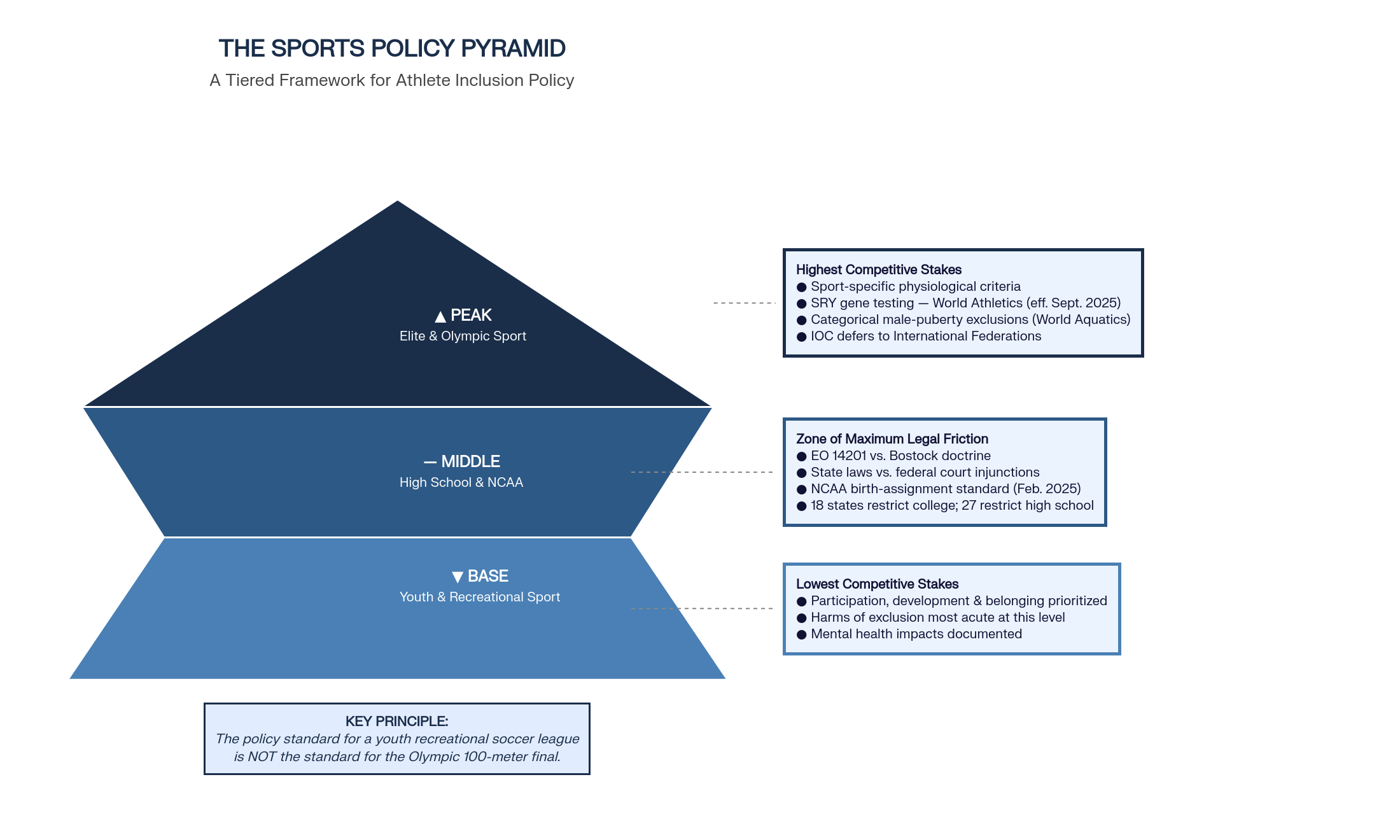
The executive order did not emerge in a vacuum. By early 2025, at least 27 states had enacted laws restricting transgender student participation in school sports consistent with their gender identity, with 18 states specifically targeting college athletics.¹² Several of these laws remained blocked in whole or in part by federal court orders. School sports in the United States are typically administered by state associations, but Title IX’s federal funding overlay means that national policy decisions immediately alter the incentives facing every school district in the country—a structural tension that EO 14201 sharpened dramatically.¹
Internationally, the policy trajectory has also shifted toward restriction. World Aquatics banned athletes who had undergone male puberty from women’s competitions in 2022. World Athletics announced in March 2025 that it would require genetic testing—specifically for the SRY gene on the Y chromosome—as a precondition for competing in the female category at world-ranking events, with the regulation taking effect September 1, 2025.⁹ At the same time, the International Olympic Committee (IOC), in its 2021 Framework on Fairness, Inclusion and Non-Discrimination on the Basis of Gender Identity and Sex Variations, had charted a different course—one that rejected categorical exclusion, emphasized sport-specific and evidence-based eligibility criteria, and grounded policy in the human rights obligations of sport.⁶
These diverging institutional responses reflect a genuine and deep scientific, ethical, and legal dispute that this document attempts to map with care and fairness.
A Note On Scope
This document focuses primarily on policies affecting transgender women competing in female categories, because that is where the overwhelming preponderance of legal, scientific, and political disputes currently arises. Some policies also directly affect transgender men—particularly athletes assigned female at birth who begin testosterone therapy—and intersex athletes. Those impacts are noted where relevant, especially in Section III. The issues are distinct and readers seeking deeper treatment of transgender men or DSD eligibility should consult the annotated bibliography.
Critical Issues: Table Of Contents
- I. The Science of Athletic Performance: What Do We Know About Biological Advantage, Hormone Therapy, and Residual Differences?
- II. The Legal Landscape: Title IX, Executive Authority, Bostock v. Clayton County, and the Constitutional Questions
- III. The Policy Architecture: How Do Current Systems at High School, College, and Olympic Levels Operate—and What Are Their Weaknesses?
- IV. The Inclusion Dimension: Human Rights, Grassroots Participation, and the Impact of Exclusionary Policies
- V. Mental Health Outcomes: The Hidden Cost of Policy-Driven Exclusion
- VI. The Ethics of Competition: Applying the Six Pillars — Fairness, Caring, and Respect
- VII. Possible Actions: A Policy Menu Across Levels of Governance
Sequential Discussion Of Critical Issues
I. The Science of Athletic Performance

“A fair-minded reading of the evidence supports sport-specific and level-specific eligibility criteria… rather than blanket bans or blanket inclusion rules.”
Major Contentions. Proponents of categorical restrictions on transgender women in sports argue that male puberty confers lasting physiological advantages—including greater lung capacity, higher bone density, greater muscle mass, and higher hemoglobin levels—that hormone therapy cannot fully reverse. Opponents argue that the science is more equivocal than this claim suggests, that performance overlap between transgender and cisgender women is substantial, and that restrictions based on this argument are not proportionate to any demonstrated competitive harm at most levels of sport.
The Evidence. The empirical literature is genuinely contested, and intellectual honesty requires acknowledging both what it shows and what it does not.
Studies do confirm that male puberty produces performance advantages. Trans women who transitioned after puberty retain some of these markers, even after extended hormone therapy. A 2021 study published in the British Journal of Sports Medicine (Roberts et al.) found that after one year of hormone therapy, transgender women still outperformed cisgender women in certain cardiovascular and strength metrics—including push-up capacity and running times—but that after two years, the performance gap narrowed significantly.² However, a 2024 study funded in part by the IOC and also published in the British Journal of Sports Medicine found a mixed pattern: transgender women performed worse than cisgender women on some measures, including certain lower-body strength and lung-function tests, while other measures, such as hemoglobin profiles—a key predictor of endurance performance—did not show the same pattern.¹⁴
A 2022 article in the Journal of the Endocrine Society reviewing the fairness literature concluded: “Opinions differ on the extent to which fair competition between trans and cis female athletes is possible,” and that “there is a great need for further studies on the athletic performance of trans people in elite sports.”¹³ A recurring conclusion in the literature is that the evidence remains limited, especially for elite competition and for athletes who transitioned before puberty.
Contact Sports and Safety. A distinct—and frequently conflated—argument concerns not competitive advantage but physical safety in contact sports such as rugby, wrestling, and martial arts. The safety argument holds that residual differences in bone density, muscle mass, and height that persist after HRT may create injury risks for cisgender female opponents. World Rugby became the first major governing body to restrict transgender women from international women’s competition, announcing its guidelines in October 2020 specifically citing safety concerns and injury risk modeling as the operative basis rather than competitive advantage alone.¹⁷ The evidence base on actual injury rates in integrated contact-sport populations remains limited; policy bodies have often relied more on biomechanical modeling and assumptions than on large observational datasets, and that limitation deserves transparent acknowledgment.
What is certain: Male puberty produces measurable physiological differences that persist, to varying degrees, after hormone therapy. What is uncertain: The extent to which these differences translate into competitive advantages—or safety risks—across different sports, at different levels of competition, after varying durations of hormone therapy. What is unknown: The long-term competitive performance trajectories of athletes who transition before puberty, a population on which virtually no longitudinal data exists.
Analysis. The scientific evidence does not support a blanket ban on all transgender athletes across all sports and all levels of competition. It also does not support the claim that no competitive differences exist. A fair-minded reading of the evidence supports sport-specific and level-specific eligibility criteria—the model endorsed by the IOC’s 2021 Framework—rather than blanket bans or blanket inclusion rules. As a matter of policy design, the IOC 2021 Framework represents the closest existing model to a sport-specific, rights-conscious approach, though it has been criticized for providing insufficient operational guidance to individual governing bodies. The World Athletics SRY gene test, effective September 2025,⁹ represents one institutional attempt to operationalize a binary biological definition of eligibility at the elite level; its scientific validity as a proxy for competitive advantage is not yet established by existing research and will generate further litigation and scholarly scrutiny.²
II. The Legal Landscape
“Whether Bostock compels Title IX protection for transgender athletes in sports—as opposed to employment—remains an open question that the Supreme Court has not directly resolved.”
Major Contentions. The Trump administration’s Executive Order 14201 treats Title IX’s prohibition on “sex” discrimination as applying only to biological sex assigned at birth, and on this basis restricts women’s sports to athletes so assigned.³ Opponents argue that the Supreme Court’s 2020 decision in Bostock v. Clayton County, which held that Title VII’s prohibition on sex discrimination encompasses discrimination based on gender identity, extends by logical and doctrinal implication to Title IX.¹⁵
The Legal Framework. Bostock v. Clayton County (2020) was a 6–3 Supreme Court decision holding that discrimination against an employee “because of sex” under Title VII necessarily includes discrimination based on gender identity and sexual orientation, because an employer who fires a transgender person treats that person differently based on how their sex compares to their gender identity.¹⁵ Justice Gorsuch, writing for the majority, explicitly disclaimed any application to athletic competition or bathroom access, but the doctrinal reasoning has been applied by multiple lower courts in Title IX contexts.¹
The Biden administration had proposed Title IX regulations in 2022 that would have limited, though not categorically prohibited, schools’ ability to ban transgender athletes from teams matching their gender identity. Biden abandoned those proposed regulations in December 2024. The Trump administration’s February 2025 executive order took the opposite approach, directing the Department of Education to treat women’s sports as reserved exclusively for cisgender women and threatening to withhold federal grants from non-compliant institutions.³
At the state level, at least four state laws—in Arizona, Idaho, Utah, and West Virginia—remained blocked by federal court orders as of early 2025, while 18 states had active laws restricting transgender college athlete participation.¹² The Supreme Court, which agreed in the summer of 2025 to take up appeals involving state bans in Idaho and West Virginia, had not issued a definitive ruling as of early 2026, though oral argument suggested a majority leaning toward upholding the bans.¹⁸ The legal landscape remains one of active, multi-front litigation with no settled national standard.
Analysis. The legal question is genuinely unresolved. Whether Bostock compels Title IX protection for transgender athletes in sports remains an open question. EO 14201 is likely to face continued court challenges. Legal scholars on both sides of the debate agree on one thing: this area of law is in flux and will not stabilize without either Congressional action or Supreme Court clarification. What is certain is that the current patchwork of conflicting state laws, executive orders, and court injunctions creates operational and compliance burdens for school districts and athletic departments that need clear, consistent rules.¹
III. The Policy Architecture
High School Level. The National Federation of State High School Associations (NFHS) does not set a single national rule; instead, it provides guidelines that individual state athletic associations adapt. As of 2025, at least 27 states had enacted statutory restrictions on transgender youth sports participation.¹² A 2025 Williams Institute analysis estimated that as of February 10, 2025, approximately 37% of transgender youth aged 13–17 in the United States lived in a state with such restrictions.¹⁶
College Level. Prior to February 2025, the NCAA had a testosterone-based policy that allowed transgender women to compete after one year of hormone therapy. Executive Order 14201 prompted the NCAA to shift to a birth-assignment standard, which is now its operative rule.⁴ The NCAA’s new policy does permit transgender men and others assigned male at birth to practice with women’s teams and to access related medical benefits, though not to compete in women’s competition. The policy also creates particular complications for transgender men—athletes assigned female at birth who begin testosterone therapy—some of whom may no longer qualify for the women’s category under which they previously competed, even when they have not sought and do not want to compete at an elite men’s level.
Olympic Level. The IOC’s 2021 Framework explicitly rejected prescriptive eligibility criteria and instead delegated standard-setting to individual International Federations (IFs), requiring that IF policies be sport-specific, evidence-based, and rights-respecting.⁶ World Aquatics has adopted categorical exclusion for athletes who have undergone male puberty. World Athletics, effective September 2025, requires SRY gene testing.⁹ Other IFs have adopted varying testosterone-based thresholds or remain without clear policies. This decentralization has produced wide divergence across sports, reflecting different mixes of evidence, risk tolerance, and political pressure within each governing body.
Weaknesses of Current Systems. The existing patchwork has several documented structural failures. First, it creates inconsistent rules for athletes at different levels of the same sport within the same country. Second, birth-assignment rules and SRY gene tests do not account for intersex athletes, individuals with differences of sex development (DSD), or athletes with complete androgen insensitivity syndrome (CAIS), all of whom may have chromosomal profiles that complicate binary categorization. Third, the enforcement mechanisms for birth-certificate and gene-testing policies risk imposing invasive verification procedures that can constitute harassment or discrimination against cisgender women who do not conform to gender norms—a harm documented in earlier decades of Olympic gender verification.² Sex-verification regimes historically have burdened women who are gender-nonconforming or simply do not meet stereotyped physical expectations, and any new verification framework must build in safeguards against those harms.
Analysis. A coherent, defensible policy architecture must solve several distinct problems simultaneously: define the purpose of sex-separated categories with precision; calibrate eligibility criteria to that purpose; apply criteria demonstrably related to competitive advantage or safety rather than to identity; build in sport-specific variation; and include robust due process protections. No existing policy fully meets all these criteria. The current U.S. approach under EO 14201 provides administrative clarity at the cost of categorical exclusion that the scientific evidence does not uniformly support.
IV. The Inclusion Dimension: Human Rights and Grassroots Participation
Major Contentions. Rights-based advocates argue that transgender athletes—particularly youth—have legally and morally cognizable rights to participate in school sports that governments and governing bodies cannot override merely to resolve hypothetical competitive concerns. Restriction advocates argue that the rights of cisgender female athletes to compete on a level playing field constitute an equally cognizable interest that the law has long recognized through the existence of sex-separated sports categories. Advocates of restrictions also argue that participation rules can affect roster spots, scholarship qualification, and championship opportunities even where the number of transgender competitors is very small—a concrete harm to cisgender women athletes that deserves engagement rather than dismissal.
The Grassroots Reality. This debate is almost entirely conducted as though it concerned elite athletes. It does not. The overwhelming majority of transgender athletes—like the overwhelming majority of all athletes—participate at recreational, youth recreational, and scholastic levels where competitive advantage is not a meaningful concern. A 2021 Center for American Progress analysis found no correlation between trans-inclusive high school sports policies and a decline in girls’ sports participation; in fact, in California and Connecticut, girls’ overall participation increased during periods with inclusive policies—by approximately 14% in California from 2014 to 2020.⁸ States with exclusive policies saw decreases in girls’ participation over the same period. This is an advocacy source and the evidence is correlational; readers should weigh it accordingly alongside other indicators.
The Williams Institute estimated in February 2025 that the Trump executive order directly affected participation by transgender women and girls across all competitive levels, from youth recreational sports through professional athletics.⁵ Participation in sports is linked to higher self-esteem, lower rates of depression, greater school belonging, and—specifically for transgender and nonbinary youth—higher academic performance.⁵
Analysis. The fairness argument, however legitimate at the elite level, cannot justify categorical exclusion at youth recreational, middle school, and high school levels where no meaningful competitive advantage has been documented and where the harms of exclusion are concrete and well-evidenced. A proportionate policy response would draw distinctions by competitive level and sport type rather than applying a single rule from peewee soccer to the Olympic finals. The limited available evidence does not show that inclusive policies reduce girls’ participation, and some state comparisons show participation increasing during periods with inclusive policies.
V. Mental Health Outcomes

Major Contentions. Policy debates about transgender athletes rarely foreground the mental health consequences of exclusion. This is a significant omission. The evidence on this point is substantial and directionally consistent.
The Evidence. A 2024 meta-analysis published in PMC/NIH, drawing on 12 studies and a cohort of 21,565 participants, found that transgender athletes faced social discrimination and inequality in sports participation at a rate of 61%, resulting in measurable mental health harms including depression, anxiety, and—critically—elevated suicide risk.⁷ The same review found that approximately 50% of transgender men and 30% of transgender women in the studied populations had attempted suicide at some point in their lives.
Transgender athletes face significantly higher rates of depression, anxiety, and trauma-related mental health challenges than their cisgender peers, and sports participation is one of the factors most strongly associated with resilience and protective mental health outcomes for this population. Williams Institute analysis found that transgender and nonbinary students who participated in sports reported higher grades and lower rates of depression than those who did not.⁵
The mechanisms are well understood. Sports provide community, structure, identity affirmation, peer belonging, and physical health benefits. Excluding a vulnerable population from these benefits does not simply deny them an extracurricular activity; it denies them a documented mental health protective factor at a time of heightened vulnerability. Policies that create barriers to participation—particularly for youth—must account for this cost.
“Excluding a vulnerable population from these benefits does not simply deny them an extracurricular activity; it denies them a documented mental health protective factor at a time of heightened vulnerability.”
Analysis. The mental health evidence is substantial and directionally consistent across the literature. A fair-minded policy analysis must weigh the competitive harms associated with inclusive policies—which remain poorly quantified at most levels of sport—against the documented, serious, and measurable mental health harms associated with exclusionary policies. Any ethical policy framework that ignores this evidence is incomplete.
VI. The Ethics of Competition: Fairness, Caring, and Respect
This section applies three of the Josephson Institute’s Six Pillars of Character to the governing question.
Fairness. Fairness in competition requires that competitors be evaluated by rules that are transparent, consistent, and relevant to the activity being judged. Sex-separated categories exist in most sports because average physiological differences between male and female bodies, established through puberty, create differences in performance potential that would otherwise make women’s competition uncompetitive. This is a legitimate purpose that the law recognizes—Title IX itself presupposes it. The ethical question is whether the eligibility criteria used to protect this purpose are proportionate to the identified risk. At elite levels, where physiological differences are directly performance-relevant—and where safety in contact sports is a distinct and legitimate concern—more restrictive standards may be ethically defensible. At recreational and scholastic levels, where the purpose of sport is developmental rather than purely competitive, blanket exclusion is ethically disproportionate. Fairness, properly understood, cuts in different directions at different levels of competition.
Caring. The ethic of caring requires policy actors to treat affected individuals as full human beings, not abstractions. Trans athletes—particularly youth—are not policy problems to be solved; they are young people who want to play. The documented mental health costs of exclusion (see Section V) impose a specific caring obligation on policymakers: you may not adopt a policy that inflicts serious and predictable harm on vulnerable individuals without a proportionate justification. The caring principle also extends to cisgender female athletes whose competitive opportunities and physical safety are legitimate concerns that deserve serious engagement rather than dismissal. Caring requires holding both populations’ interests in view simultaneously.
Respect. Respect requires treating all persons with dignity regardless of their characteristics. Policies framed entirely in birth-sex terms—including EO 14201—are experienced by many transgender advocates as denying recognition of their gender identity, and that experience is a legitimate ethical concern regardless of one’s view on the underlying policy merits. Respect does not require accepting every policy claim made in the name of transgender inclusion; it requires that the dignity of transgender athletes not be instrumentalized in service of political messaging, and that the dignity of cisgender female athletes not be used as a rhetorical prop by those whose primary motivation is not athletic fairness. The framing of the debate matters ethically, not only legally.
Trustworthiness and Responsibility. A policy system that reverses direction with each election cycle raises separate ethical concerns. Athletes and institutions cannot plan programs, award scholarships, or make training investments around rules that may be reversed by the next administration or the next legislative session. The ethical obligation of responsibility requires that governing bodies pursue durable, deliberative, and institutionally credible policy processes rather than reactive executive actions. The current state of affairs—in which the NCAA changed a policy affecting hundreds of student-athletes in under twenty-four hours under federal pressure—does not meet that standard.

VII. Possible Actions: A Policy Menu
No single policy solution is optimal across all levels, sports, and competitive contexts. The following menu is organized by governance level and drawn from existing frameworks, scholarly proposals, and institutional precedents.
At the Federal Level:
- Congress should clarify Title IX’s application to transgender athletes through legislation rather than leaving the question to executive orders and contested agency interpretation. This would provide institutions with legal certainty and reduce the harm of inconsistent state-by-state rules.
- Any federal standard should incorporate level-specific distinctions: the standard appropriate for youth recreational sports is not the standard appropriate for Olympic competition.
- The Department of Education should engage in notice-and-comment rulemaking—with broad stakeholder participation including transgender athletes, cisgender female athletes, medical experts, and civil rights organizations—rather than relying on executive orders that can be reversed with each change of administration.
At the State Level:
- States that have enacted categorical bans should consider graduated frameworks that distinguish between youth recreational sport, middle and high school competition, and collegiate competition.
- States should not enact enforcement mechanisms that require invasive verification procedures (such as genital examinations or genetic testing of all student-athletes); if verification is deemed strictly necessary, they should rely on existing, non-invasive medical or administrative documentation—such as physician statements or school enrollment records.
At the NCAA and High School Association Level:
- The NCAA’s current policy, adopted under political pressure in less than twenty-four hours, has not been subject to the kind of deliberative process that a question of this complexity warrants. The association should commission an independent scientific review and develop sport-specific standards, as the IOC 2021 Framework recommends.⁶
- The NFHS should develop a model policy for state adoption that provides age-appropriate, sport-specific, and evidence-based guidance, and should convene a national stakeholder consultation before finalizing it.
At the International Level:
- International Federations should follow the IOC 2021 Framework in developing sport-specific and evidence-based policies, but the IOC should provide more operational guidance and stronger enforcement mechanisms to prevent the current divergence across IFs.
- World Athletics’ SRY gene test warrants independent scientific review. The test identifies a chromosomal binary but does not directly measure hemoglobin levels, VO₂ max, bone density, or muscle mass—the markers actually relevant to competitive advantage in specific sports. Its validity as a fairness proxy remains contested.⁹
Across All Levels:
- All governing bodies should provide robust mental health and support services for transgender athletes navigating eligibility processes, and should build in due process protections including appeal rights, confidentiality, and independent review.
- Research investment is urgently needed. The scientific gap on pre-pubescent transition, long-term performance trajectories, safety data in contact sports, and sport-specific impacts is a genuine obstacle to evidence-based policymaking. The IOC, national governments, and major sports associations should fund this research rather than waiting for litigation to force the question.
Endnotes
¹ On the legal flux of Title IX interpretation and the structural tension between federal funding authority and state sports governance, see: Villanova Law, “The Future of Women’s Sports After Bostock,” Villanova Sports and Entertainment Law Journal (2021); Seton Hall University School of Law, “Protections for LGBTQ+ Students and Athletes: Title IX in Light of Bostock” (2023). The courts of the Fourth and Ninth Circuits have applied Bostock reasoning to Title IX; the Eleventh Circuit has not. No circuit split has been definitively resolved by the Supreme Court as of April 2026.
² Roberts, T.A. et al., “Effect of gender affirming hormones on athletic performance in transgender women and men,” British Journal of Sports Medicine 55(11) (2021): 577–583. Historical context: Olympic chromosome testing from 1968–1998 was found by the IOC itself to be scientifically invalid and harmful to intersex athletes and gender-nonconforming women. The IOC abandoned it in 1999. See also: Ljungqvist, A., “Gender Verification in Competitive Sport: Vital, or Violating Human Rights?” (2000); Fenichel, P. et al., Journal of Clinical Endocrinology & Metabolism (2013).
³ Executive Order 14201, “Keeping Men Out of Women’s Sports,” February 5, 2025. Full text at whitehouse.gov.
⁴ NCAA Board of Governors, “NCAA Announces Transgender Student-Athlete Participation Policy Change,” February 6, 2025. Available at ncaa.org.
⁴ᵃ NCAA President Charlie Baker, public remarks reported December 18, 2024; confirmed in multiple news accounts including The Hill (December 18, 2024) and BBC Sport (February 7, 2025). The total NCAA student-athlete population is approximately 510,000.
⁵ Williams Institute, UCLA School of Law, “The Impact of Transgender Sports Participation Bans on Students,” February 13, 2025. This report includes findings on academic performance and mental health outcomes.
⁶ IOC, “Framework on Fairness, Inclusion and Non-Discrimination on the Basis of Gender Identity and Sex Variations,” November 2021. Published in British Journal of Sports Medicine 57(1) (2023): 26.
⁷ Li, T. et al., “Societal Discrimination and Mental Health among Transgender Athletes,” PMC/NIH, January 15, 2024. Meta-analysis of 12 studies, N=21,565.
⁸ Center for American Progress, “Fact Sheet: The Importance of Sports Participation for Transgender Youth,” March 17, 2021. Note: CAP is an advocacy organization; this analysis is correlational, not causal, and should be read accordingly.
⁹ World Athletics, “World Athletics Introduces SRY Gene Test for Athletes Wishing to Compete in the Female Category,” press release, July 29, 2025; regulations effective September 1, 2025. Available at worldathletics.org.
¹⁰ Pew Research Center, “Americans’ Complex Views on Gender Identity and Transgender Issues,” June 28, 2022. Found 58% of U.S. adults favoring birth-sex competition requirements for transgender athletes. Note: this poll is from 2022; more current polling should be consulted before drawing conclusions about present-day opinion.
¹¹ NBC News poll, June 2023: 69% of U.S. adults saying transgender athletes should compete only on teams corresponding to their birth sex, up from 62% in 2021. Polling sponsor and methodology should be verified before publication.
¹² Movement Advancement Project (MAP), “Bans on Transgender Youth Participation in Sports,” updated 2025. Available at lgbtmap.org.
¹³ “Fairness for Transgender People in Sport,” Journal of the Endocrine Society (Oxford Academic), April 30, 2022.
¹⁴ 2024 BJSM study findings summarized by San Francisco Department of Public Health, “Trans Women in Sports: Facts Over Fear,” March 26, 2025. Primary citation should be confirmed against the original IOC-funded BJSM article before final publication.
¹⁵ Bostock v. Clayton County, 590 U.S. (2020), 140 S. Ct. 1731. Majority opinion by Justice Gorsuch.
¹⁶ Statista, “U.S. Transgender Youth Subject to School Sports Bans,” February 9, 2025.
¹⁷ World Rugby, “Transgender Guidelines,” October 2020. Available at world.rugby. World Rugby cited injury risk modeling and safety concerns as the primary basis for its exclusion policy. See also: “Why the World Rugby Guidelines Banning Trans Athletes from the Women’s Game Are Reasonable,” The Conversation, January 21, 2021.
¹⁸ Supreme Court of the United States, agreed to hear appeals involving state transgender sports bans from Idaho and West Virginia, announced summer 2025. Oral argument held January 2026. See: SCOTUSblog, “Supreme Court Appears Likely to Uphold Transgender Athlete Bans,” January 12, 2026; NPR, January 13, 2026.
Annotated Bibliography
For Readers Seeking Greater Depth
Anderson, Eric, and Travers, Ann. Transgender Athletes in Competitive Sport (Routledge, 2017). Though pre-dating most recent policy shifts, this remains the most thorough academic treatment of inclusion issues, drawing on sociological, medical, and legal frameworks. Particularly strong on the grassroots and youth dimensions that are underrepresented in elite-focused policy debates.
Cavanagh, Sheila L., and Theberge, Nancy. Sport, Feminism, and Transgender Politics (various collected volumes, 2020–2023). Situates the transgender athlete debate within the longer history of sex verification in sport and feminist critiques of the category of “woman” in competitive athletics. Essential for understanding why the question is not merely biological or medical.
Harper, Joanna. Sporting Gender: The History, Science, and Stories of Transgender and Intersex Athletes (Rowman & Littlefield, 2020). Harper is a medical physicist and transgender athlete who has consulted for the IOC; this is the most detailed treatment of the physiological evidence available in book form. Harper argues that meaningful competition between trans women and cis women is possible with appropriate regulation, and provides supporting empirical data.
International Olympic Committee. “Framework on Fairness, Inclusion and Non-Discrimination on the Basis of Gender Identity and Sex Variations” (November 2021), republished in the British Journal of Sports Medicine (2023). The most comprehensive institutional policy framework available; readable, principled, and carefully footnoted. Should be required reading for any school administrator or governing body official designing transgender participation policy.
Karkazis, Katrina, and Jordan-Young, Rebecca. “The Trouble with Too Much T,” New York Times op-ed (2014); and “Debating a Testosterone ‘Sex Gap,'” Science (2019). Leading scholarly critiques of testosterone-based eligibility frameworks, arguing that testosterone levels are poor proxies for competitive advantage and that their use in policy reflects cultural assumptions as much as science.
Pew Research Center. “Americans’ Complex Views on Gender Identity and Transgender Issues” (June 2022). The best available recent national polling data on public attitudes toward these issues. Note that 58% favoring birth-sex competition requirements and 64% favoring anti-discrimination protections in housing and employment are simultaneously majority positions—the public holds these in tension rather than resolving them. This is a political reality policymakers must understand, and more current polling should be consulted as it becomes available.
Sharrow, Elizabeth A. Sport and the Politics of Transgender Exclusion (working papers and articles, 2021–2024). Examines how transgender athletic exclusion laws function as political rather than purely regulatory instruments, analyzing their relationship to broader anti-transgender legislative campaigns.
Current Developments Note (as of April 2, 2026): World Athletics’ SRY gene test regulations, announced July 2025, were in effect for the 2025 World Athletics Championships. The Williams Institute and ACLU have noted ongoing litigation against EO 14201 in multiple federal circuits. The Supreme Court, which took up state transgender sports ban cases from Idaho and West Virginia in the summer of 2025, heard oral argument in January 2026 and appeared likely to uphold the bans, though no ruling had issued as of this writing. Any policy guidance offered here should be verified against current case law before operational application.
Leave a Reply
Want to join the discussion?Feel free to contribute!