
Fairness, Inclusion, And The Fight For The Female Category: A Wysk Special Report
Can sports governing bodies design eligibility systems that preserve meaningful competitive fairness and safety in the female category without unlawfully excluding transgender athletes from the full range of benefits that sport confers?
This is the governing question in one of the most contested policy disputes in modern civic life. In 2025, the United States federal government used executive power to restructure the rules of competitive sport. President Donald Trump signed Executive Order 14201, “Keeping Men Out of Women’s Sports,” directing federal agencies to interpret Title IX as reserving women’s sports exclusively for individuals assigned female at birth.³ The NCAA changed its policies within twenty-four hours.⁴
More than a third of transgender youth aged 13–17 in America now live in states where their participation in school sports is legally restricted.⁵ The stakes are real: for transgender athletes whose dignity and sense of belonging are at issue; for cisgender female athletes whose competitive opportunities and physical safety are also legitimate concerns; and for schools caught between competing legal mandates.
The Science: What We Know And What We Don’t
“A fair-minded reading of the evidence supports sport-specific and level-specific eligibility criteria rather than blanket bans or blanket inclusion rules.”
Proponents of categorical restrictions argue that male puberty confers lasting physiological advantages—greater lung capacity, higher bone density, and greater muscle mass—that hormone therapy cannot fully reverse. Opponents argue that the science is more equivocal than that claim suggests and that blanket bans are not proportionate to demonstrated harm at most levels of sport.
The empirical literature is genuinely contested. Context matters: before the executive order, NCAA President Charlie Baker said that fewer than ten of approximately 510,000 NCAA athletes were known to be transgender—a reminder that this is a debate about policy design, not a widespread competitive crisis.⁴ᵃ
Studies do confirm that male puberty produces performance advantages. A 2021 study in the British Journal of Sports Medicine found that after one year of hormone therapy, transgender women still outperformed cisgender women in certain cardiovascular and strength metrics, but that after two years the gap narrowed significantly.² A 2024 IOC-funded study found a mixed pattern: transgender women performed worse than cisgender women on some measures, including lower-body strength, while hemoglobin profiles—a key predictor of endurance—showed no meaningful difference.¹⁴
A recurring conclusion in the literature is that the evidence remains limited, especially for elite competition and for athletes who transitioned before puberty.¹³
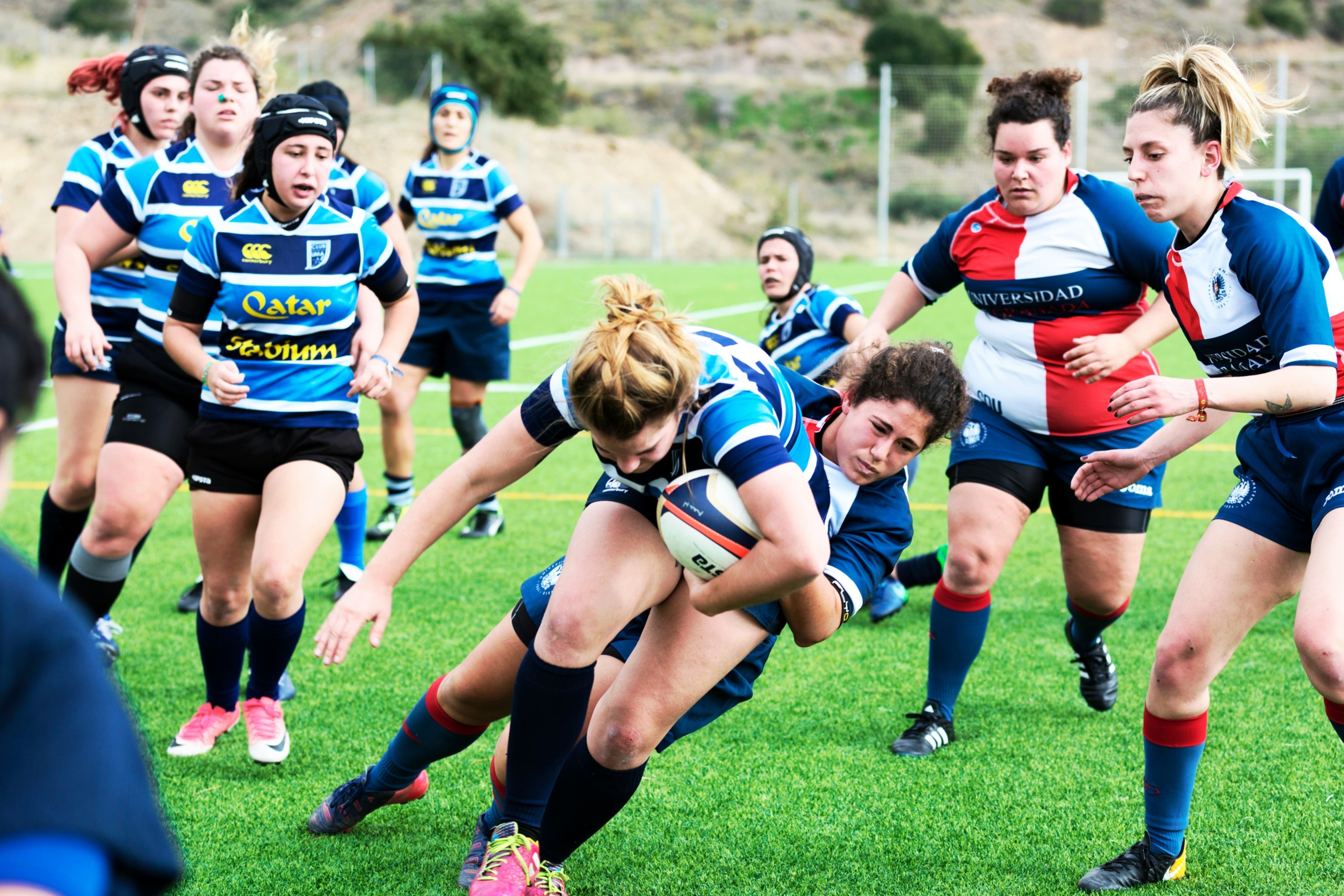
There is also a distinct safety argument in contact sports. World Rugby restricted transgender women from international women’s competition in 2020 based on injury-risk modeling.¹⁷ The evidence base on actual injury rates in integrated contact-sport populations, however, remains limited, with policy bodies relying more on biomechanical modeling than on observational datasets.
The scientific evidence does not support a blanket ban across all sports and all levels of competition. It also does not support the claim that no competitive differences exist. The World Athletics SRY gene test, effective in 2025, represents one effort to operationalize a binary biological definition at the elite level; its validity as a fairness proxy will continue to face scholarly and legal scrutiny.⁹
The Legal Battleground
The Trump administration’s EO 14201 treats Title IX’s prohibition on “sex” discrimination as applying only to biological sex assigned at birth.³ Opponents argue that the Supreme Court’s 2020 decision in Bostock v. Clayton County—which held that employment discrimination based on sex includes gender identity—extends by logical implication to Title IX.¹⁵
Justice Neil Gorsuch, writing for the Bostock majority, expressly disclaimed any application to athletic competition.¹⁵ But lower courts have applied the reasoning to Title IX contexts.¹ At the state level, 27 states have enacted statutory restrictions on transgender youth sports participation.¹² The Supreme Court agreed in 2025 to hear appeals involving state bans in Idaho and West Virginia and heard oral argument in early 2026, but had not yet issued a definitive ruling at the time of writing.¹⁸
What is certain is that the current patchwork of state laws, executive orders, and court injunctions creates serious operational and compliance burdens for school districts that need clear, consistent rules.¹
The Grassroots Reality And Mental Health
This debate is often conducted as though it concerns elite athletes. It does not. The overwhelming majority of transgender athletes participate at recreational, youth, and scholastic levels where competitive advantage is not a meaningful concern. Advocates of restrictions, however, note that participation rules—even with few transgender competitors—can affect roster spots, scholarship opportunities, and championship access for cisgender women. That is a concrete concern and deserves engagement, not dismissal.
A 2021 Center for American Progress analysis found no correlation between trans-inclusive high school sports policies and a decline in girls’ sports participation; in California and Connecticut, girls’ overall participation increased during periods with inclusive policies. This analysis is correlational, not causal, and comes from an advocacy organization, so it should be weighed accordingly.⁸
The mental health consequences of exclusion, however, are serious. A 2024 meta-analysis found that transgender athletes faced social discrimination and inequality in sports participation at a rate of 61%, with measurable mental health harms including depression, anxiety, and elevated suicide risk.⁷ Approximately 30% of transgender women in the studied populations had attempted suicide at some point.⁷
Sports provide community, structure, identity affirmation, and belonging. The Williams Institute found that transgender and nonbinary students who participated in sports reported higher grades and lower rates of depression than those who did not.⁵
“Excluding a vulnerable population from these benefits does not simply deny them an extracurricular activity; it denies them a documented mental health protective factor at a time of heightened vulnerability.”
The Ethics Of Competition
Applying the Josephson Institute’s Six Pillars of Character reveals the depth of the conflict.
Fairness requires that competitors be judged by transparent, consistent rules relevant to the activity. Sex-separated categories exist because average physiological differences established through puberty create differences in performance potential. The ethical question is whether eligibility criteria are proportionate to the identified risk. At elite levels, where physiology is directly performance-relevant, restrictive standards may be ethically defensible. At youth recreational levels, where the purpose of sport is developmental rather than purely competitive, blanket exclusion is ethically disproportionate—particularly given the documented mental health costs.
Caring requires treating transgender athletes—especially youth—as full human beings, not policy abstractions. The documented mental health costs of exclusion impose a caring obligation on policymakers. That obligation extends as well to cisgender female athletes, whose competitive opportunities and physical safety are legitimate concerns.
Respect requires treating all persons with dignity. Policies framed entirely in birth-sex terms are experienced by many as denying recognition of their gender identity. Conversely, the dignity of cisgender female athletes should not be used as a rhetorical prop by those whose primary motivation is political messaging rather than athletic fairness.
Responsibility highlights the danger of policy whiplash. A system that reverses direction with each election cycle prevents athletes and institutions from planning programs, scholarships, and training. Governing bodies must pursue durable, deliberative processes rather than reactive executive actions.⁴
A Path Forward
No single policy solution is optimal across all levels. The policy standard appropriate for a youth recreational soccer league is not the standard for the Olympic 100-meter final.
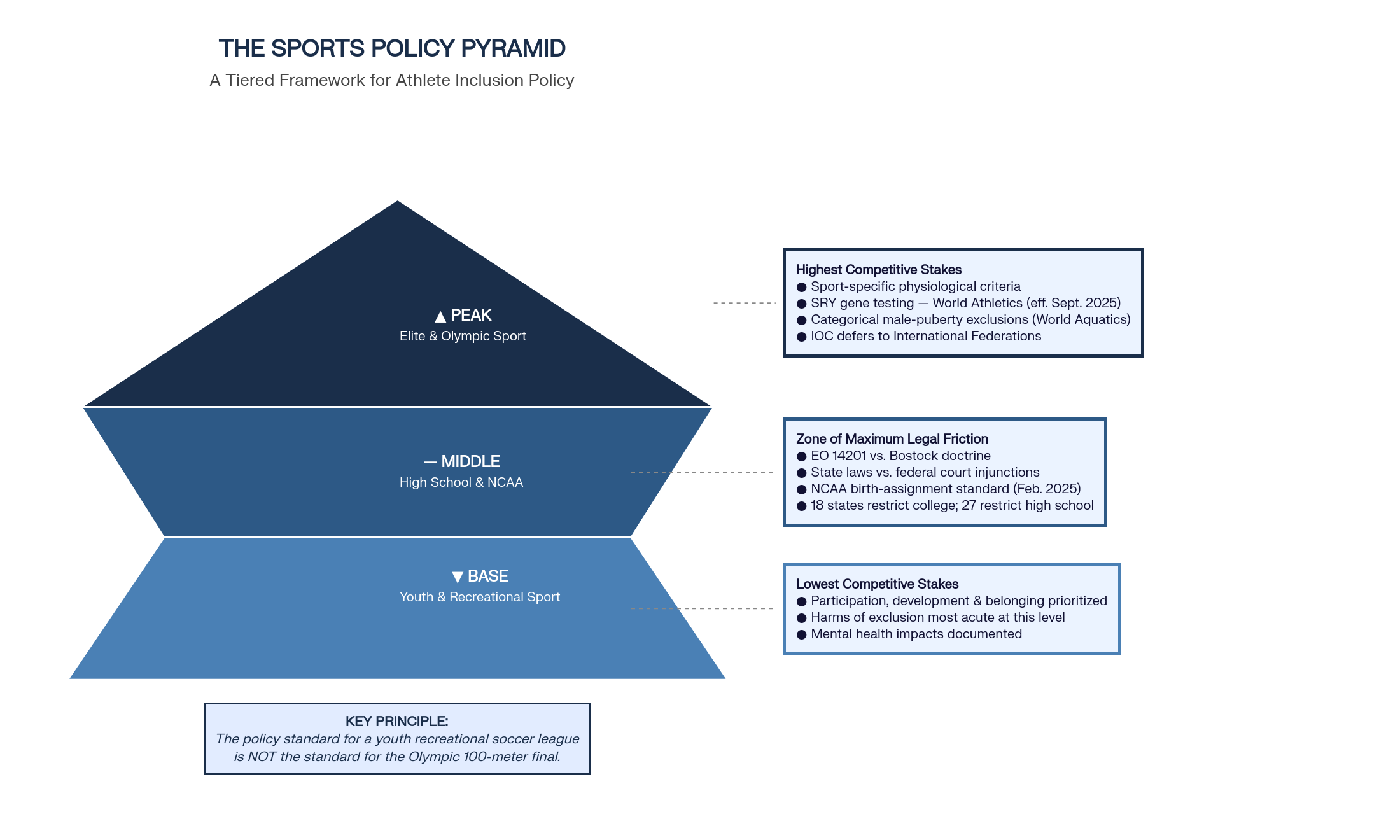
However, governing bodies can take several practical steps.
Federal and state action: Congress should clarify Title IX through legislation rather than leaving schools to navigate shifting executive orders. States that have enacted categorical bans should consider graduated frameworks that distinguish between youth recreational sport and collegiate competition. States should also avoid invasive verification procedures, especially because birth-assignment and gene-testing rules may misclassify intersex athletes or individuals with chromosomal differences that complicate binary categorization.
Athletic associations: The NCAA and high school associations should commission independent scientific reviews and develop sport-specific standards, as the IOC 2021 Framework recommends.⁶ The IOC’s framework rejects one-size-fits-all criteria and instead delegates standard-setting to sport-specific federations guided by evidence.
Research and support: There is a genuine scientific gap regarding pre-pubescent transition, safety data in contact sports, and long-term performance trajectories. Major sports associations should fund this research rather than waiting for litigation to force the issue. Governing bodies should also provide robust mental health support and due-process protections for athletes navigating eligibility decisions.
Until policy reflects the basic reality that sports serve different purposes at different levels, the conflict over transgender athletes will continue to generate legal conflict, political division, and real human cost.
Endnotes
¹ Villanova Law, “The Future of Women’s Sports After Bostock,” Villanova Sports and Entertainment Law Journal (2021).
² Roberts, T.A. et al., “Effect of gender affirming hormones on athletic performance in transgender women and men,” British Journal of Sports Medicine 55(11) (2021): 577–583.
³ Executive Order 14201, “Keeping Men Out of Women’s Sports,” February 5, 2025.
⁴ NCAA Board of Governors, “NCAA Announces Transgender Student-Athlete Participation Policy Change,” February 6, 2025.
⁴ᵃ NCAA President Charlie Baker, public remarks reported December 18, 2024. The total NCAA student-athlete population is approximately 510,000.
⁵ Williams Institute, UCLA School of Law, “The Impact of Transgender Sports Participation Bans on Students,” February 13, 2025.
⁶ IOC, “Framework on Fairness, Inclusion and Non-Discrimination on the Basis of Gender Identity and Sex Variations,” November 2021.
⁷ Li, T. et al., “Societal Discrimination and Mental Health among Transgender Athletes,” PMC/NIH, January 15, 2024.
⁸ Center for American Progress, “Fact Sheet: The Importance of Sports Participation for Transgender Youth,” March 17, 2021. Note: This analysis is correlational, not causal, and comes from an advocacy organization.
⁹ World Athletics, “World Athletics Introduces SRY Gene Test for Athletes Wishing to Compete in the Female Category,” July 29, 2025.
¹² Movement Advancement Project (MAP), “Bans on Transgender Youth Participation in Sports,” updated 2025.
¹³ “Fairness for Transgender People in Sport,” Journal of the Endocrine Society, April 30, 2022.
¹⁴ 2024 BJSM study findings summarized by San Francisco Department of Public Health, March 26, 2025. Note: Original BJSM citation should be substituted prior to final print.
¹⁵ Bostock v. Clayton County, 590 U.S. (2020).
¹⁷ World Rugby, “Transgender Guidelines,” October 2020.
¹⁸ SCOTUSblog, “Supreme Court Appears Likely to Uphold Transgender Athlete Bans,” January 12, 2026.
Leave a Reply
Want to join the discussion?Feel free to contribute!